


For years, organizations have invested heavily in dashboards believing that better visualisation would produce better decisions. Dashboards became the universal answer to performance management: colourful sheets of KPIs, sliced by region, product, and function. Yet leaders increasingly realise a paradox. They have more data than ever, but decisions still move slowly. Meetings remain overloaded. Escalations continue. Execution gaps persist.
The problem is not lack of information. The problem is that dashboards describe reality; they do not shape it.
The next frontier is the creation of decision engines: systems that interpret signals, prioritise actions, trigger workflows, and guide teams autonomously. These engines do not wait for leadership reviews. They operate continuously in the background, ensuring that decisions move at the speed the business requires, not the speed that human coordination allows.
At a time when volatility is the rule rather than the exception, businesses need decision systems that function predictably even when leaders are absent. This shift represents not just a technological evolution but a redesign of how organisations think, plan, and execute.
Rising Urgency for Autonomous Decision Systems
Several structural forces make traditional decision-making insufficient.
1. Information velocity has surpassed human bandwidth
Signals now emerge in minutes. Pricing shifts, customer churn triggers, supply-chain delays, fraud anomalies, regulatory alerts. Expecting human teams to manually review and interpret these signals in real time is impractical. Decision engines consume these signals continuously, distinguishing noise from relevance.
2. Cross-functional complexity has intensified
Most decisions today span multiple teams. A pricing decision requires inputs from finance, sales, marketing, operations, and market intelligence. A dashboard cannot resolve competing incentives or fragmented ownership. A decision engine orchestrates these dependencies.
3. Dashboards promote observation, not action
Dashboards answer “What happened?”
Decision engines answer “What should happen now?”
This difference defines strategic agility.
4. Leadership time is becoming the scarcest resource
As businesses expand, leaders cannot be the approval point for every inflection. Decision engines give organisations a way to operate with embedded intelligence, not continuous supervision.
Dashboards democratise visibility. Decision engines democratise action.
Why Dashboards Alone Fall Short
Dashboards emerged during an era when the central problem was lack of information. Businesses needed clarity, transparency, and the ability to monitor performance consistently across units. The assumption was simple: if people see data, they will act.
But decades of experience show otherwise. Information does not guarantee alignment or timely action. Several limitations are now widely acknowledged:
Dashboards are static while decisions are dynamic
A dashboard is a snapshot. Decisions unfold across time. Actions depend on thresholds, patterns, anomalies, and predictive context that dashboards rarely encode.
Teams interpret the same metric differently
What looks like poor performance to operations may appear as strategic prioritisation to marketing. Dashboards do not harmonise interpretation.
Dashboards rely on human initiative
Someone must check the data, connect dots, and escalate. In many organisations, this step introduces delay, inconsistency, and missed opportunities.
Dashboards fragment decisions
Each function has its own dashboard, generating its own alerts. A decision engine unifies signals into a coherent narrative:
This is the situation. Here is what must be done. Here is who must do it.
Dashboards help you see your business. Decision engines help your business run itself.
Lessons from Companies Building Automated Decision Architectures
This shift is already visible in organisations that have pursued data-driven transformation not as reporting upgrades but as redesigns of how decisions are made.
 Amazon’s retail and logistics systems operate on embedded decision rules that adjust inventory placement, pricing, and routing continuously. Decisions that once required planners now occur algorithmically within guardrails set by leaders. The insight is simple: scale requires decisions to move faster than humans can coordinate.
 UPS transformed its delivery optimisation through an engine that analyses millions of route combinations daily. Drivers still make judgment calls, but the system sets the baseline plan. This illustrates how engines complement human judgment without replacing it, allowing the enterprise to operate predictably at massive scale.
 Netflix uses decision engines extensively to determine content recommendations, promotional positioning, and even regional content investment strategies. These engines integrate behavioural signals in real time, enabling decisions that no team could execute manually.
These companies demonstrate a principle relevant for every industry: when decision logic becomes systemised, organisations become capable of scaling judgment, not just operations.
Building the Architecture for Autonomous Decisions
A decision engine is not a single tool. It is a layered architecture integrating data, interpretation, rules, and action. The transition from dashboards to decision engines requires rethinking four critical components.
1. Signal Infrastructure
Decision engines depend on clean, timely, high-resolution signals. This includes transactions, behavioural data, operational telemetry, risk indicators, and contextual information such as weather, market trends, or regulatory updates.
The purpose is not to collect everything but to collect the right things with the right latency.
2. Interpretation Logic
This is where engines outperform dashboards. Instead of waiting for humans to spot patterns, engines use models to identify anomalies, predict demand shifts, or assess risk exposure. Importantly, interpretation logic must be transparent. Leaders should understand why the engine triggers certain recommendations.
3. Decision Rules and Guardrails
This layer defines what the system can decide, what it can trigger, and where human judgment is required. Guardrails maintain accountability while enabling automation. For example, a pricing engine may be allowed to adjust within a certain range but require approval for significant deviation.
4. Automated Action Pathways
Decision engines act. They trigger workflows, notifications, adjustments, or escalations. This turns insight into impact.
Together, these layers allow organisations to shift from decision-making as a meeting to decision-making as a continuous system.
Choosing the Right Automation Approach for Decisions
Not all decisions benefit from the same kind of automation. Three broad approaches dominate modern architecture.
1. Robotic Process Automation
Useful for decision-adjacent tasks like data collection, reconciliation, or rule-based validation. RPA does not make decisions, but it ensures decision engines have clean inputs and stable downstream execution.
2. Workflow and API Automation
Ideal for end-to-end flows. When a decision engine identifies a risk or opportunity, workflow automation ensures the right steps happen across teams without manual hand-off. This creates consistency and reduces cycle time.
3. Agentic AI Systems
The emerging class of autonomous digital agents can interpret unstructured inputs, suggest decisions, and interact with systems dynamically. These agents will redefine decision-making in areas like customer service, financial review, supply chain exceptions, and fraud detection.
The most sophisticated organisations use all three approaches in combination, designing automation around the decision—not the other way around.
What CXOs Must Rethink
The rise of decision engines requires leaders to re-examine long-standing beliefs about governance, accountability, and managerial control.
Leaders must shift focus from reviewing data to designing decisions – Most executives still spend the majority of their time interpreting dashboards. The next generation of leaders will instead architect decision logic and guardrails.
Delegation must evolve beyond people – Historically, delegation meant assigning authority to managers. Now, delegation includes systems. This requires clarity, trust, and a philosophical shift in how accountability is distributed.
The organisation must operate with fewer escalations – Decision engines reduce reliance on leadership bottlenecks. Teams act earlier, with more confidence, within defined parameters.
Governance becomes proactive rather than reactive – Instead of reviewing what has already happened, leaders monitor the health and behaviour of decision systems.
These shifts elevate leadership from operational oversight to operational design.
A Conceptual Framework for Decision Engines
A decision engine requires coherence across four layers:
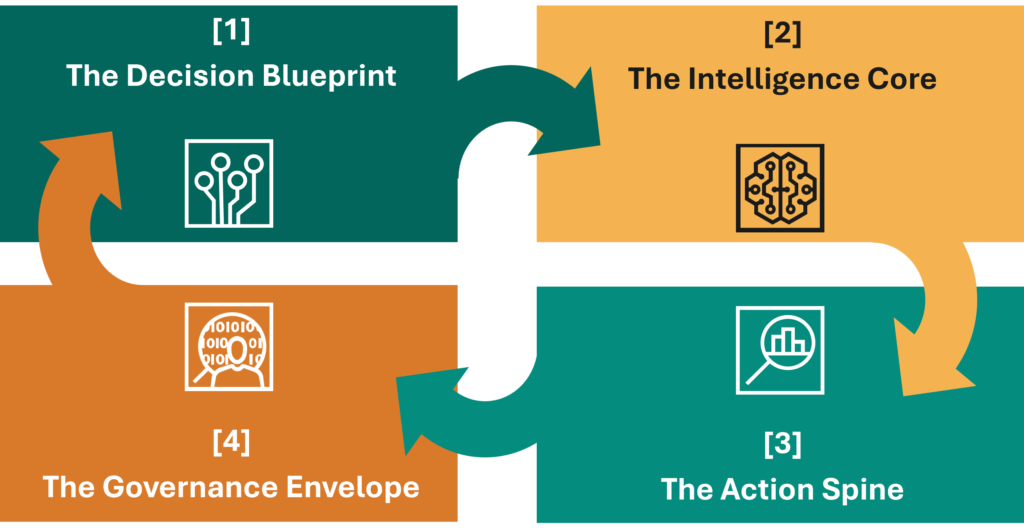
- The Decision Blueprint
What decisions must be automated? What principles guide them? What business outcomes define success?
- The Intelligence Core
Data, models, heuristics, signals. This includes predictive insights, anomaly detection, and behavioural cues that enable anticipatory action.
- The Action Spine
The workflows and system integrations that turn decisions into commitments. Without an action spine, insights remain abstract.
- The Governance Envelope
Defines thresholds, exceptions, oversight, and periodic review mechanisms.
Together, these layers transform decision-making from a meeting-driven activity into a continuous organisational capability.
Why Decision Engines Matter Most for Large, Complex Enterprises
Enterprises with scale experience decision friction more acutely. Multiple business lines, large workforces, diverse geographies, and layered governance create noise that slows execution. Decision engines address this by:
- Creating uniform interpretation of signals – Teams no longer argue over dashboards; they respond to a shared logic.
- Reducing operational variability – Decisions follow defined pathways, improving predictability.
- Accelerating time to action – Approvals shrink. Handoffs disappear. Escalations reduce.
- Strengthening strategic alignment – Engines ensure that daily decisions reflect leadership intent, even when leaders are not present.
In large organisations, this shift becomes a competitive differentiator.
The Forward View
The next decade will redefine how decisions are made across enterprises. Organisations will move from visibility to velocity, from human-dependent workflows to hybrid systems where humans guide strategy and engines guide execution. Decision engines will not replace leadership. They will extend it, ensuring that the organisation behaves with the consistency, speed, and foresight that modern markets demand. The companies that thrive will be those that treat decision-making as a system to be designed rather than a process to be monitored.
______________________________________________________________________________________________________________________________
About Strategy Studio
At Strategy Studio, we help CXOs to solve complex business problems – from growth strategy and customer experience to financial transformation, process optimisation, and credit analytics. Our work blends rigorous analysis, practical execution, and deep functional expertise. To exlpore, schedule a free 30 minutes exploratory discussion HERE.

How to Assess Your Organization’s Financial Health for Strategic Growth
Why financial health has become a strategic constraint, not a reporting exercise Most organizations believe they understand their financial health

Cost Diagnostics: Identifying and Reducing Hidden Costs
Cost has returned to the centre of boardroom conversations, but not for the reasons many leaders assume. This is

Designing the Liquid Enterprise – Creating Organizations That Can Reconfigure Themselves in Real Time
For years, executives have described their organizations as “agile,” “adaptive,” or “responsive.” Yet in moments of disruption, many discover