


Most strategy teams were built for a world that no longer exists. They were designed to synthesise reports, build financial models, analyse markets, and translate insights into recommendations. That model worked when competitive cycles were measured in years and data moved slowly. Today, competitive advantage depends not on how well a strategy team interprets information, but on how well it builds the systems that generate and interpret information continuously. By 2030, strategy teams will resemble technical units, architects of decision intelligence rather than creators of slide decks. The organisations that excel will be those where strategy teams manage data pipelines, deploy automation, train AI models, and operate real-time decision engines that shape the behaviour of the business. The shift is profound: strategy becomes less about periodic planning and more about building the infrastructure that guides the organisation daily.
This article outlines how strategy teams must transform, what tools they need, and how global leaders are already redesigning the strategic function for the decade ahead.
Why Strategy Needs a Tech Stack Now
Three converging shifts redefine what strategy teams must do.
First, information now moves faster than strategic processes. Customer behaviour, supply-chain dynamics, regulatory change, and competitor moves produce signals continuously. By the time these insights reach leaders through conventional channels, the window for action often closes.
Second, organisations sit on exponentially more data, but strategic interpretation remains manual and slow. Traditional analysis cannot cope with the volume or velocity of signals emerging from digital ecosystems.
Third, AI is becoming a foundational business capability, not a specialised tool. Strategy teams must be able to identify AI opportunities, evaluate risks, and embed intelligence into workflows.
As markets become more dynamic, strategy itself must evolve from episodic planning to continuous sensing, interpretation, and intervention.
How Strategy Work Has Changed
Strategy teams historically prioritised research and framing: analysing markets, diagnosing problems, synthesising insights. This work remains important, but it is no longer sufficient.
Organizations now require strategy teams that can:
-
- Build automated insights pipelines rather than one-off analyses
- Translate business questions into data flows
- Design AI-driven models that predict demand, churn, or operational risk
- Create decision frameworks that operate without constant escalation
- Partner with engineering teams to operationalise decision logic
- Govern the ethical and operational boundaries of AI systems
In other words, strategy teams must operate like technical strategists: fluent in business, data, and systems thinking.
Companies like Amazon, Walmart, DBS Bank, and Netflix show what this looks like in practice. Their strategy functions work closely with product, analytics, and engineering teams to build the logic that governs daily decisions. Strategy becomes part of the operating system, not an advisory layer.
What a Strategy Tech Stack Must Include
By 2030, high-performing strategy teams will work with a defined stack across four layers: data infrastructure, intelligence tooling, and automation systems, all wrapped inside a governance frameworks.
A. Data Infrastructure: The Foundation of Intelligent Strategy
Strategic decisions depend on signal quality. Teams need access to clean, structured, integrated data across customer, financial, operational, and market domains.
Leaders must ensure strategy teams have:
-
- Direct access to enterprise data lakes
- Semantic layers that structure definitions consistently
- Pipelines that refresh data in real time or near real time
- APIs that allow ingestion of external and alternative data sources
 DBS Bank’s transformation is instructive. Its strategy and analytics teams built shared data models across risk, customer journeys, and operations to ensure that every decision was informed by unified intelligence. The outcome was faster execution and sharper resource allocation. Without strong data foundations, strategy teams default to PowerPoint rather than real-time insight.
B. Intelligence Tools: Moving Beyond Static Dashboards
Dashboards show what happened. Strategy teams need tools that show what is likely to happen next and what should be done about it.
By 2030, organisations will rely on:
- Predictive models for churn, demand, pricing, risk
- Simulation engines that test scenarios and trade-offs
- LLM-powered analysis assistants that summarise large datasets instantly
- Market intelligence tools that track competitive signals automatically
- Decision engines that evaluate thresholds, constraints, and recommended actions
 Microsoft is already moving in this direction. Its internal strategy units use advanced forecasting models to guide cloud capacity planning, pricing actions, and product rollouts. The emphasis is shifting from observing markets to anticipating inflection points.
C. Automation Systems: Turning Insight Into Action
Insight has limited value if it does not translate into execution. Strategy teams now require automation capabilities that allow them to:
- Push decisions into workflow systems
- Trigger actions in CRM, ERP, or operational tools
- Automatically escalate deviations
- Monitor performance continuously
 Walmart’s supply chain systems demonstrate the power of this integration. Predictive models identify inventory risk, and automated workflows adjust orders, trigger replenishment, or alert store managers. Human judgment intervenes only when deviation exceeds a defined threshold. Automation does not replace strategic decision-making. It operationalises strategic intent.
AI Practices Every Strategy Team Must Adopt
AI is no longer experimental. It is becoming a standard component of operational and strategic decision-making. Strategy teams need a working model for AI adoption across the enterprise.
Build Use-Case Portfolios, Not AI Projects – High-performing companies prioritise AI efforts based on value pools, repeatability, and decision leverage, not novelty.
Netflix’s content investment decisions rely on models trained on behavioural data, creative patterns, and consumption indicators. These are not isolated experiments; they form a decision framework embedded in operations.
Treat Models as Products – Strategy teams must collaborate with engineering to maintain, monitor, and improve AI models over time. Models degrade. Data shifts. Behaviour evolves. Continuous improvement is essential.
Establish Guardrails and Ethical Governance – AI systems must operate with transparency and boundaries. Strategy teams are responsible for defining what the system can and cannot decide, ensuring that automation aligns with the values and risk appetite of the organisation.
Why Every Strategy Team Needs Engineers
Future-ready strategy teams will include data engineers, ML engineers, automation specialists, and decision scientists. The skill set looks fundamentally different from traditional corporate strategy teams. The reason is structural. Strategy is no longer explanatory; it is operational. It does not end at the recommendation. It must extend into the design of systems that execute the recommendation.
This integration is already visible in leading enterprises:
-
- Amazon embeds strategy professionals inside technical teams
- Netflix integrates algorithmic teams with content strategy
- JPMorgan uses cross-functional pods for analytics-driven product decisions
- Tesla relies on joint strategy-engineering groups for manufacturing intelligence
The boundary between strategy and operations is dissolving. The new strategist must design systems, not slides.
A New Leadership Lens for CXOs
The role of CXOs changes dramatically as decision intelligence becomes embedded in the organisation.
Leaders must move from reviewing decisions to designing decision systems – Instead of asking “What does the dashboard show?”, leaders must focus on “How does the system decide?”.
This shift transforms governance from supervision to architecture.
Leaders must embrace transparency and real-time visibility – Modern strategy does not rely on monthly reviews.
It relies on continuous monitoring, automated alerts, and live performance signals.
Leaders must invest in data and AI literacy across the top team – A decision engine is only as strong as the leadership understanding behind it. CXOs must know enough to question assumptions, validate logic, and set meaningful guardrails.
Framework for Tech-Enabled Strategy Organizations
The evolution toward tech-enabled strategy requires four integrated layers.
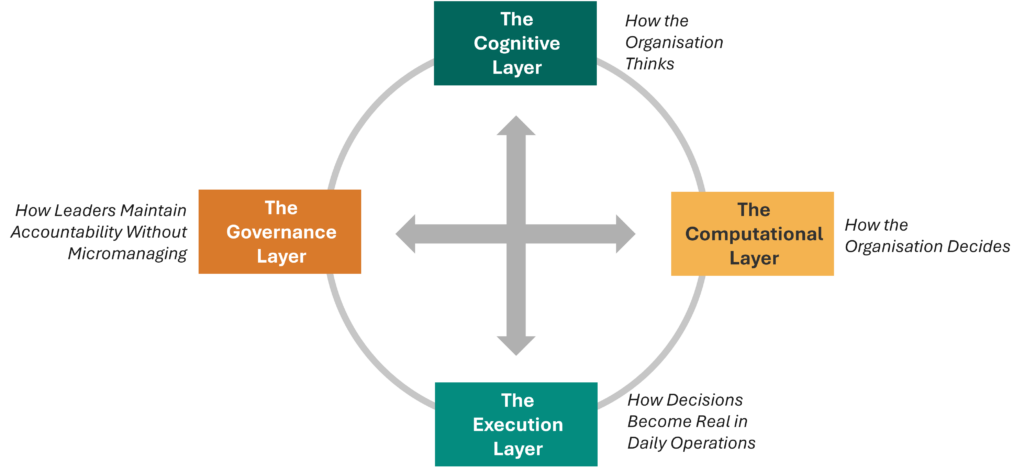
1. The Cognitive Layer: How the Organisation Thinks
This layer defines how the organisation perceives and interprets the world.
It includes:
-
- Signal architecture: Which signals matter, how they enter the system, and at what frequency
- Interpretive logic: Predictive models, heuristic rules, pattern-recognition intelligence, scenario engines
- Strategic sensemaking: Structures for integrating external shifts (market, geopolitical, competitive) into internal decision logic
This layer addresses a fundamental truth: Strategy begins with perception. You cannot decide well if you do not sense well. The Cognitive Layer transforms strategy teams from passive analysts into the architects of the organisation’s “perception system”.
2. The Computational Layer: How the Organisation Decides
If the Cognitive Layer explains how the enterprise understands reality, the Computational Layer determines what the enterprise does with that understanding.
This layer includes:
-
- Decision models and thresholds
- Trade-off logic embedded into algorithms
- Constraint frameworks (capacity limits, capital intensity, risk boundaries)
- Decision rights encoded into system behaviour – not just org charts
- AI agents that execute reasoning steps previously done by analysts
This is where organisations operationalise their “strategic brain”. A strategy team that designs the Computational Layer is no longer describing decisions – it is engineering decision-making itself. This is the layer most absent from traditional corporations, and it is the layer that companies like Amazon, UPS, Netflix, and DBS have begun to master.
3. The Execution Layer: How Decisions Become Real in Daily Operations
It defines how decisions “hit the ground” across the business.
Components include:
-
- Automated operational pathways (API-driven workflows, RPA triggers, order-routing logic)
- Integrated system activation across CRM, ERP, OMS, WMS, finance, supply chain
- Real-time feedback loops that inform the Cognitive Layer when actions diverge from expectations
- Exception-handling architecture that routes “edge cases” to humans without breaking flow
This is not process automation. This is strategic execution automation – embedding strategic intent directly into operational systems. When built correctly, the Execution Layer ensures the organisation behaves in line with strategy even when leaders are not present. This layer converts strategy from “plans for people” into instructions for the enterprise.
4. The Governance Layer: How Leaders Maintain Accountability Without Micromanaging
This is the most misunderstood layer, and also the most critical.
The Governance Layer defines:
-
- Where human judgment enters the loop
- How the system is monitored and audited
- How data quality, model integrity, and ethical boundaries are maintained
- How frequently decision logic is reviewed and recalibrated
- What is reversible vs. irreversible, automated vs. supervised
- Who takes responsibility when automated decisions create unintended outcomes
Most companies treat governance as oversight. Modern organisations treat governance as system stewardship. A well-designed Governance Layer ensures:
-
- Automation does not drift
- Models do not degrade
- Decisions stay aligned with risk appetite
- Teams maintain psychological safety and clarity
- Leadership focuses on architecture, not firefighting
This is where senior leaders evolve from reviewers to designers of decision ecosystems. By 2030, competitive advantage will depend less on strategic insight and more on strategic infrastructure: the systems that sense, interpret, decide, and act.
Companies with strategy tech stacks benefit from: faster cycle times, greater consistency across regions and units, sharper investment decisions, more resilient operations and flatter escalation paths, creating leaders who spend more time shaping the future than reacting to the present. The shift is decisive. Organisations that fail to modernise their strategic capabilities risk slower reflexes, higher costs, and persistent execution gaps. The advantage belongs to companies that build Strategic Infrastructure, not just strategic plans.
Final Perspective
Strategy is no longer a planning discipline. It is an engineering discipline for organisational intelligence. The next decade will reward companies that treat strategy teams as architects of decision systems, not producers of presentations. The winners will be those that build a unified stack of data, models, automation, and governance, allowing the organisation to operate with clarity even in ambiguity. Strategy teams must evolve. By 2030, the most effective strategists will not simply analyse the business. They will design how the business thinks.
______________________________________________________________________________________________________________________________
About Strategy Studio
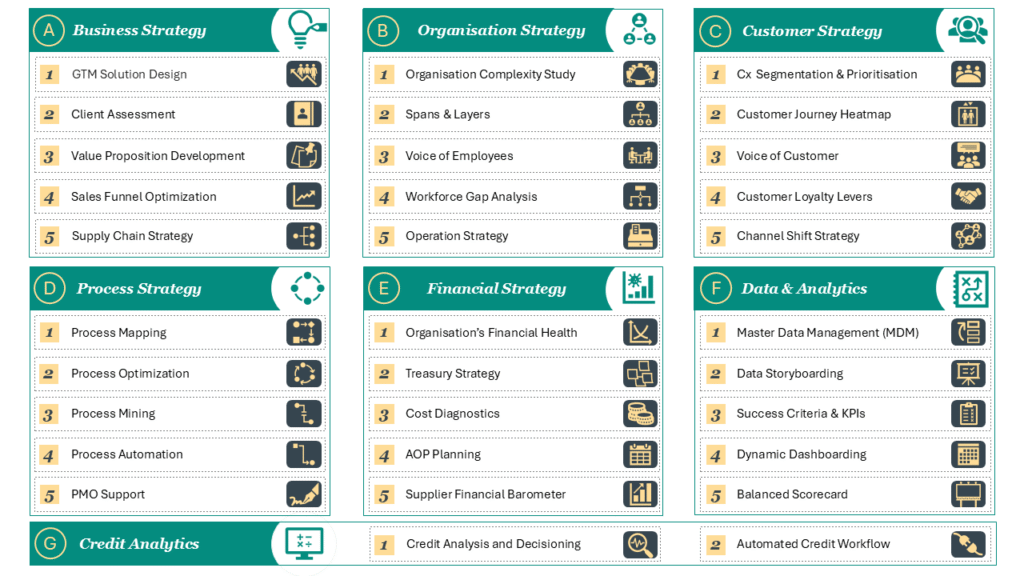
At Strategy Studio, we help CXOs to solve complex business problems – from growth strategy and customer experience to financial transformation, process optimisation, and credit analytics. Our work blends rigorous analysis, practical execution, and deep functional expertise. To exlpore, schedule a free 30 minutes exploratory discussion HERE.

How to Assess Your Organization’s Financial Health for Strategic Growth
Why financial health has become a strategic constraint, not a reporting exercise Most organizations believe they understand their financial health

Cost Diagnostics: Identifying and Reducing Hidden Costs
Cost has returned to the centre of boardroom conversations, but not for the reasons many leaders assume. This is

Designing the Liquid Enterprise – Creating Organizations That Can Reconfigure Themselves in Real Time
For years, executives have described their organizations as “agile,” “adaptive,” or “responsive.” Yet in moments of disruption, many discover