


Automation has moved from being a back-office efficiency tool to a central force shaping how organizations operate, compete, and grow. As enterprises expand product lines, deepen customer engagement, and diversify into new markets, their operating systems often become the limiting factor – slowing decisions, increasing variability, and raising the hidden cost of coordination. What was once a tactical enabler is now a strategic necessity. Automation, thoughtfully designed and implemented, allows organizations to reimagine how work flows, stabilize processes, and create the operational headroom required for growth.
Yet many companies approach automation narrowly, treating it as a way to reduce manual effort rather than an opportunity to redesign the architecture of execution. The real power of automation lies not in replacing tasks, but in building an operating model capable of delivering consistency and speed at scale.
Why Automation Matters in This Moment
Three shifts in the business landscape have fundamentally elevated the importance of automation.
1. Rising complexity in how work gets done
Modern organizations manage a level of product, geographic, regulatory, and data complexity unmatched in previous decades. Manual approaches, no matter how skilled the workforce, cannot deliver the reliability or throughput required in an environment built on constant change.
2. Customer expectations that exceed legacy capabilities
Customers today expect immediacy, transparency, and accuracy. Manual processes, by design, introduce variability. Automation gives companies the ability to deliver consistently and predictably, even as customer volumes fluctuate.
3. Digital transformation that exposes operational gaps rather than hides them
Technology reveals inefficiencies. Analytics uncover inconsistencies. Integrations require stable workflows. Without automation, digital investments amplify – not eliminate – process friction.
The organizations that thrive in this environment treat automation as a strategic capability rather than a technology project.
When Processes Become Barriers to Growth
Processes rarely break suddenly. They degrade slowly. A process that once worked begins to accumulate exceptions. A new regulation introduces additional verification steps. A regional team modifies the workflow to fit local needs. Over time, the once-simple flow becomes a complex sequence with inconsistent ownership and unpredictable outcomes.
What emerges is a set of common symptoms:
- Teams spend more time coordinating than executing
- Cycle times lengthen even as effort increases
- Customer experience becomes variable
- Digital tools fail to scale because workflows are unstable
At this stage, leaders often assume they need more people. In reality, they need better process design, reinforced by automation that removes friction rather than accelerates it.
Lessons from Global Leaders: How Automation Redesigns Work
Organizations that unlock meaningful automation value do not start with technology – they start with purpose.
Amazon: Automation as a Growth Enabler
 Amazon’s logistics network combines robotics, real-time routing intelligence, and automated sortation in a way that allows the business to scale non-linearly. What distinguishes Amazon is not the sophistication of its tools but its insistence on embedding automation into process architecture, ensuring that growth does not dilute operational reliability.
Siemens: Automation for Precision
 Siemens uses robotics and adaptive control systems to reduce variation in manufacturing. The company’s automation philosophy is grounded in stability: if a process is precise, predictable, and instrumented, quality improves without trading off speed.
Starbucks: Automating to Protect the Human Experience
 Starbucks simplified beverage assembly, automated certain replenishment routines, and redesigned store workflows. The intent was not to reduce labour but to free baristas to focus on customer engagement, strengthening brand experience through operational clarity.
These examples show that successful automation requires a disciplined understanding of value – not just efficiency, but consistency, speed, and strategic focus.
Automation Methods: Choosing the Right Tools for the Right Problems
Modern automation is multi-dimensional. Leaders must understand the strengths and limits of each approach to deploy them intelligently.
1. Robotic Process Automation (RPA)
Best used for stable, repetitive, rules-based tasks such as reconciliations, report generation, and data transfers. RPA excels at reducing errors and increasing throughput, but it struggles when processes change frequently or when inputs are unstructured.
RPA stabilizes existing routines – it does not reinvent workflows.
2. Workflow & API Automation
Where RPA automates tasks, workflow automation redesigns entire processes. It reduces handoffs, enforces business rules, and enables straight-through processing. This approach demands cleaner processes and harmonized data but delivers stronger end-to-end control and lower long-term maintenance.
Workflow automation reshapes the process itself, enabling scale with fewer exceptions.
3. Agentic AI
The newest frontier.
Agentic AI systems interpret unstructured data, perform contextual reasoning, and coordinate multi-step workflows autonomously. They handle tasks that require judgment, such as reviewing contracts, triaging claims, or drafting responses. Unlike RPA or workflow automation, Agentic AI introduces cognitive automation – automation that thinks, not just executes.
Agentic AI expands the automation frontier into areas where variability and ambiguity previously made automation impractical.
What Leaders Often Misjudge About Automation
A consistent set of misconceptions limits automation’s impact.
Automation is not synonymous with digitization
Many organizations digitize broken processes, making them faster but no less flawed. Automation creates value only when it is paired with process redesign.
Automation does not eliminate the need for talent
It shifts talent from repetitive activity to higher-value decision-making, customer engagement, and problem solving. People become more important – not less.
Automation requires governance, not just deployment
Without clear ownership, decision thresholds, and escalation logic, automated processes drift into inconsistency or bypass controls.
The highest-performing organizations treat automation as part of their operating model, not their IT roadmap.
A Strategic Framework for Scalable Automation
A robust automation strategy aligns four architectural layers:
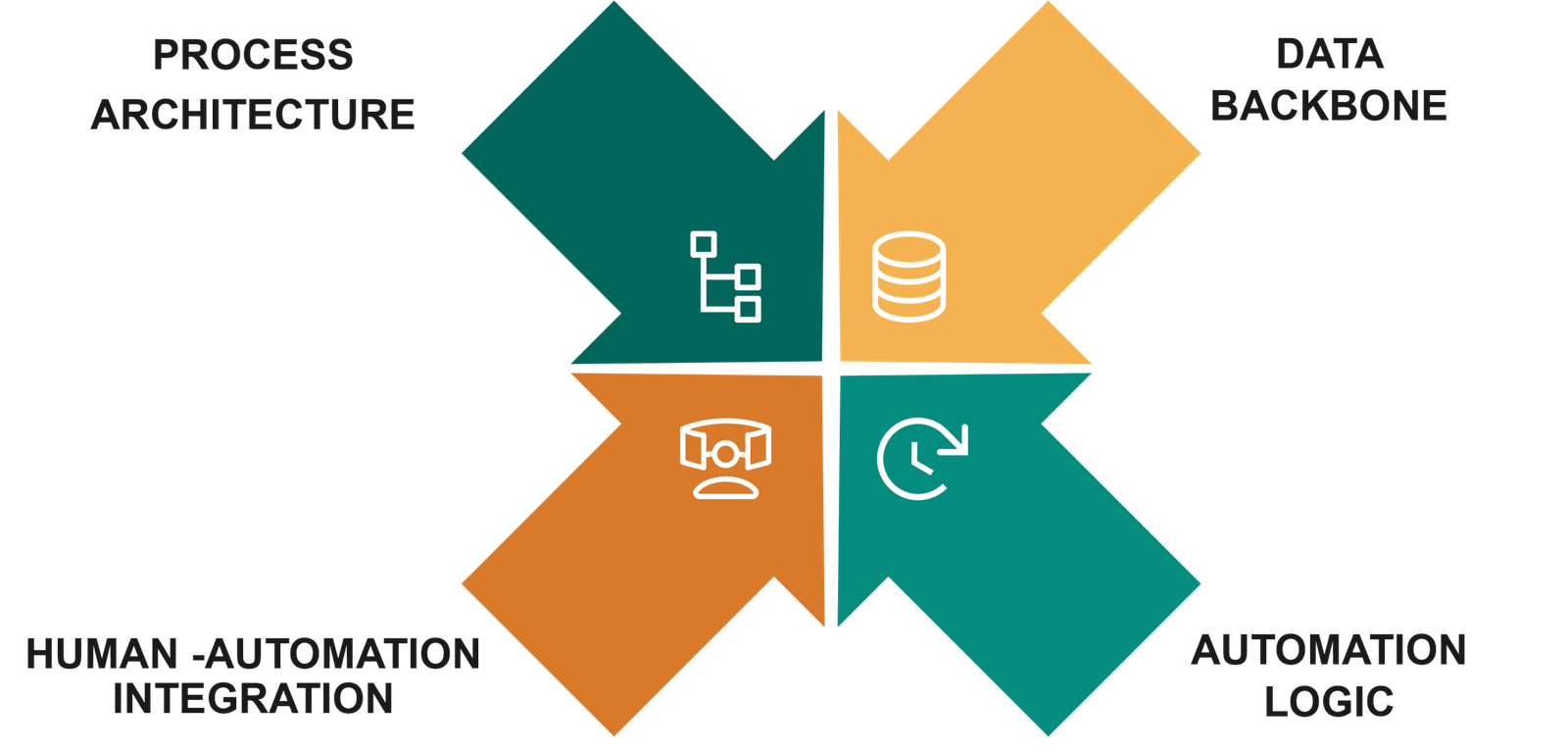
1. Process Architecture – Define what work should achieve, not just how it is done. Remove unnecessary steps, harmonize variations, and stabilize flow before automating.
2. Data Backbone – Automation relies on clean, structured, accessible data. Without this, automation amplifies errors at scale.
3. Automation Logic – Match automation tools to the problem type:
- RPA for repetitive tasks
- Workflows/APIs for structured throughput
- Agentic AI for cognitive and variable work
The goal is appropriate automation, not maximal automation.
4. Human – Automation Integration – Automation should enhance human work – surfacing insights, reducing low-value effort, and allowing teams to concentrate on judgment, creativity, and service. Together, these layers create a self-reinforcing operating rhythm capable of supporting both present and future growth.
Where Automation Redefines Enterprise Performance
Automation offers disproportionate benefits to scaled organizations – those with multiple regions, large workforces, or wide product portfolios. Several dynamics explain why:
Automation expands managerial capacity Leaders spend less time firefighting and more time shaping strategy.
Operational risk declines Consistency reduces compliance failures and operational surprises.
Customer experience becomes more reliable Automation smooths out variability, enabling predictable delivery.
Growth becomes sustainable Automation allows organizations to absorb increased workload without proportional increases in headcount or governance.
In essence, automation transforms the enterprise from a set of parallel functions into a cohesive, integrated operating system.
Looking Ahead: Automation as a Strategic Capability
The next stage of automation will integrate learning systems, real-time adaptation, and autonomous decisioning. Organizations that treat automation as episodic will struggle to keep pace. Those that build automation into the architecture of work – governed, measured, continuously improved – will operate with greater clarity and speed. Automation is not simply a lever for efficiency; it is a pathway to organizational maturity and strategic resilience. It allows companies to scale intelligently, respond early to disruption, and create space for innovation. The companies that lead in the next decade will not be the ones with the most automation. They will be the ones that use automation to elevate human potential, stabilize complexity, and fuel sustainable growth.
______________________________________________________________________________________________________________________________
About Strategy Studio
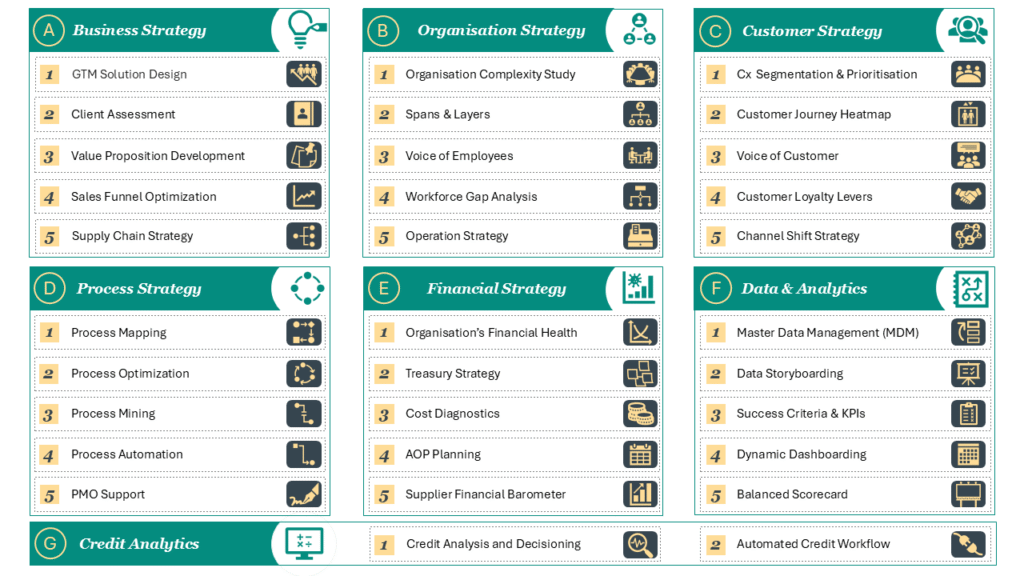
At Strategy Studio, we help CXOs to solve complex business problems – from growth strategy and customer experience to financial transformation, process optimisation, and credit analytics. Our work blends rigorous analysis, practical execution, and deep functional expertise. To exlpore, schedule a free 30 minutes exploratory discussion HERE.

How to Assess Your Organization’s Financial Health for Strategic Growth
Why financial health has become a strategic constraint, not a reporting exercise Most organizations believe they understand their financial health

Cost Diagnostics: Identifying and Reducing Hidden Costs
Cost has returned to the centre of boardroom conversations, but not for the reasons many leaders assume. This is

Designing the Liquid Enterprise – Creating Organizations That Can Reconfigure Themselves in Real Time
For years, executives have described their organizations as “agile,” “adaptive,” or “responsive.” Yet in moments of disruption, many discover